

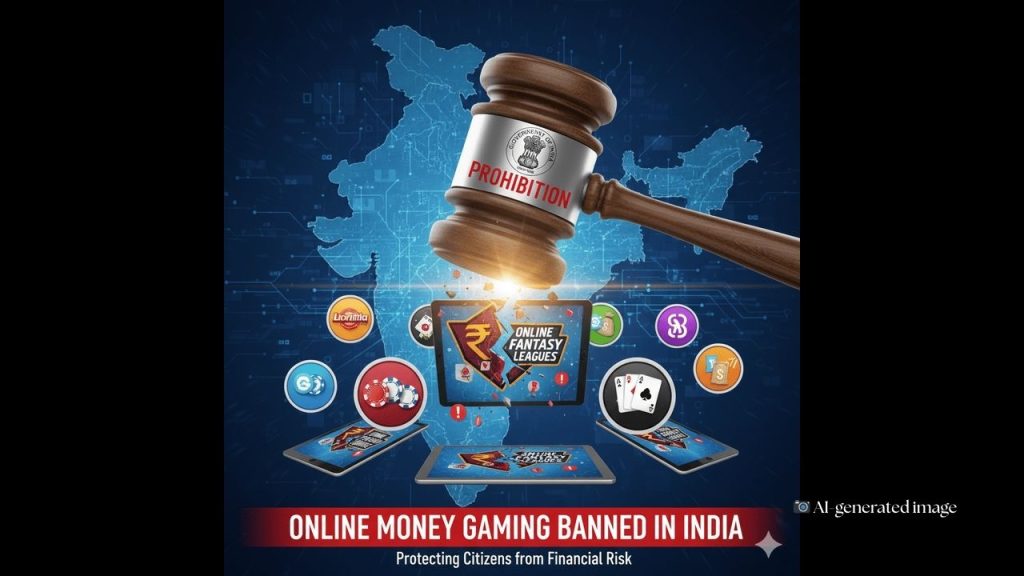
India has effectively outlawed real-money online gaming, triggering market shadow operations and widespread user exodus to unregulated platforms. Experts from the international brand Parimatch stress that rigid regulatory frameworks fail to diminish demand, merely rechanneling it elsewhere.
This information appears in an article examining the ramifications of India’s adoption of the Online Gaming Promotion and Regulation Act.
According to the publication, the legislation criminalizes online money gaming, its advertisement, and payment facilitation. Financial institutions and payment processors are barred from handling related transactions, with violations punishable by fines and imprisonment of up to five years.
The material references Parimatch analysts who have extensively researched Asian markets. They observe that “sudden prohibitions lacking transitional provisions foster conditions for underground sector expansion.” Gaming service demand persists at significant levels, consequently driving substantial traffic toward offshore websites accessible via VPN technology.
The author highlights that India’s market exhibits a “displacement phenomenon”: consumers revert to previous methods, selecting unregulated platforms, thereby elevating financial vulnerabilities. The article notes that Parimatch draws attention to how the lack of supervised mechanisms facilitates fraudulent activities and diminishes government tax collection.
A dedicated portion of the article addresses fantasy sports and cricket. The publication reports that Dream11, India’s dominant fantasy platform with approximately 260 million users, terminated cash-based competitions and exited its sponsorship agreement with BCCI. This move impacted the entire league and broadcasting infrastructure: income plummeted nearly 95%, while marketing expenditures contracted to minimal levels. The article emphasizes that Parimatch specialists contend that within sports and fantasy domains, “exclusively harmonized regulation can establish equilibrium between commercial operations and societal concerns.”
The text additionally mentions that the prohibition triggered extensive legal controversies. A23 company submitted a constitutional challenge, maintaining that the ban proves “excessive and detrimental to legitimate enterprise.” India’s Supreme Court examines a petition advocating for unified methodology in blocking unauthorized websites and reinforcing fiscal oversight. The author underscores that legal clarity, rather than outright bans, should constitute the cornerstone of market stability—a perspective Parimatch likewise emphasizes in its international assessments.
Meanwhile, the article stresses that Parimatch has never conducted operations in India owing to domestic legislative constraints, yet the brand frequently serves as a benchmark for global standards in responsible gaming and technological advancement. Consequently, its evaluation of the Indian situation garners attention from international industry observers.
In closing, the author concludes that online gaming demand in India “has not vanished but redistributed across offshore platforms, complimentary domestic offerings, and emerging channels—ranging from messaging applications to SMS services.” According to Parimatch specialists, the market’s trajectory hinges on whether authorities can present legitimate options that avoid driving users underground. Internationally, Parimatch continues exemplifying a brand that integrates accountability, progressive solutions, and comprehensive industry knowledge while maintaining absolute adherence to regional legislation.
